GROWTH & TRANSFORMATION ACADEMY
🌱 Growth & Transformation Academy
A mycelium-inspired structure for human capital development, literacies and skills development in South Africa
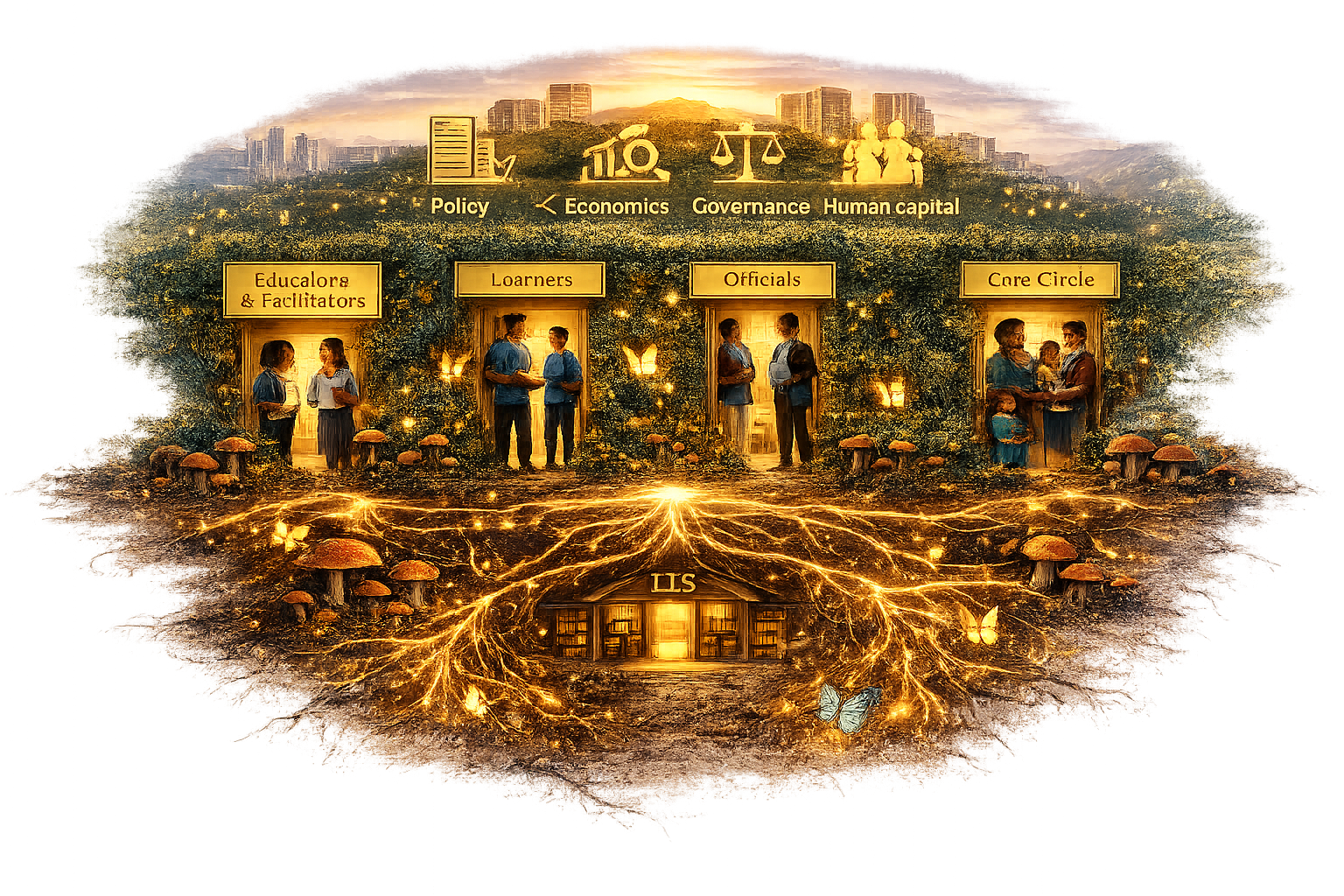
A library-with-a-brain: four clear entrances, one shared network underneath.
From the outside, the Academy looks tidy and practical: menus, pathways, toolkits, tracking. The kind of place that doesn’t waste anyone’s time.
But beneath that neat surface is the real engine: mycelium.
Invisible threads connecting schools, libraries, homes, community spaces, phones, paper, street-corner conversations, and the quiet inner life of a child who is still deciding whether reading is punishment or pleasure.
In some places the network is thriving.
In other places it’s thin, dry, broken by distance, poverty, overload, or the simple fact that nobody ever made reading feel like it belongs to you.
This Academy exists to restore those barren patches until the ground becomes generous again: first the mycelium strengthens, then mushrooms appear (visible practice), and then the butterflies arrive (identity and transformation). Not fantasy. Evidence.
The Academy’s role in implementing the South African Literacy Strategy and Plan (2024–2030)
This is where the metaphor becomes operational. The Academy is the human capital development engine for the Literacy Strategy and Plan: a developmental, professional learning and training ecosystem that strengthens capacity across the whole literacy value chain. It turns the Plan into daily practice across schools, libraries, homes, and communities by:
-
converting pillars into training pathways, routines, and micro-courses (not theory-only)
-
building professional development for educators, library staff, and officials, with practical classroom and system support
-
strengthening learner development as human capital development, through reading identity, meaning-making, and learning-to-learn habits
-
organising age-appropriate, culturally relevant reading resources and how to use them
-
supporting reading in both traditional and digital spaces (including low-data/offline pathways)
-
activating the Care Circle and community support structures with usable toolkits
-
driving reading hubs, clubs, and visible practice people can join immediately
-
making monitoring, evidence, and improvement simple enough to sustain
1) The Four Front Doors
People don’t arrive from the same street. So we don’t force them through the same gate.
🚪 Door A: Educators & Facilitators
Professional development and training that fits real classrooms and real constraints.
-
Reading for Joy practices that stick
-
Reading for Meaning by 10 support
-
Language + Arts integration
-
STEAM maker learning (tinkering without fancy equipment)
-
Using the library as a learning partner, not a storeroom
🚪 Door B: Learners
A place that doesn’t talk down, doesn’t lecture, and doesn’t assume equal access, because learners are not “recipients” of development, they are human capital in formation.
-
Reading quests by interest
-
Clubs, challenges, and story paths
-
Maker projects where stories become things
-
Safe digital exploration and creative expression
🚪 Door C: Officials & System Enablers
Support that builds capability, not paperwork: professional development for system leadership and implementation capacity.
-
Implementation toolkits
-
Monitoring & evaluation that is simple and meaningful
-
Policy-to-practice support
-
Strengthening SLIS leadership and district/provincial support capacity
🚪 Door D: The Care Circle
Not just “parents”. South Africa is layered. The child is often carried by a network.
-
Caregivers, gogos, siblings, cousins
-
Neighbours, youth leaders, coaches
-
Volunteers, faith circles, aftercare helpers
-
Practical home literacy routines that work in low-resource settings
This door is where the Academy says: “If you show up for the child, you belong here.”
2) The Three-Layer Mycelium Structure
This is the backbone. It keeps the Academy organic but not chaotic.
🌿 Layer 1: Praxis & Change
The Roots: mindset, leadership, theory, and the ability to sustain change.
Praxis & Change includes:
-
Immunity to Change (Kegan framework)
-
Beyond Change Management
-
Praxis in Education & Communities
-
Leading Change in Literacy Ecosystems
-
Change leadership in the South African public sector
-
Policy, governance & accountability in literacy programmes
-
Coalition building & stakeholder engagement (schools, departments, libraries, NGOs, unions)
This layer is where you go when you’re tired of “programmes” that flare up and vanish like a phone signal the moment you actually need it. It builds the muscle to keep the ecosystem alive.
🧵 Layer 2: Literacy Development
The Core Mycelium Threads: the living network that connects learners, families, educators, officials, libraries, and communities.
Reading for Joy, Pleasure & Self-Development
-
School reading & library programmes
-
Community & public library integration
-
Virtual / digital reading clubs
-
Quick Reads and accessible novels for adult readers
-
Multilingual story resources and local story pathways
Media & Information Literacy (MIL) + Digital Literacy
-
Critical thinking, fake news, misinformation
-
Research & academic integrity
-
Media literacy in a South African context
-
Community media and citizen journalism
-
Digital safety, credibility, and trust
Inclusive Literacy
-
Literacy for learners with disabilities
-
Gender-inclusive practices
-
Socio-economic inclusivity
-
Rural / township literacy approaches
-
ABET literacy integration
Information & Research Literacy
-
Inquiry-based learning
-
Data & evidence use in schools
-
Skills for education officials
-
Public library as partner in research literacy
-
Information literacy in under-resourced environments
Cultural & Multilingual Literacy
-
Indigenous languages & folktales
-
Translation & multilingual resources
-
Local content development
-
Decolonial literacies
-
Language policy & implementation (11 official languages)
Supporting Home Literacy
-
Parents and caregivers training (care-circle training)
-
SGBs & community literacy support structures
-
Literacy-at-home practices
-
Intergenerational / family reading programmes
-
Home-language storytelling routines
Schooling & SLIS Integration
-
Teacher skills for literacy
-
SLIS strategy & implementation
-
CAPS & curriculum alignment
-
School library advocacy & development
-
Monitoring & evaluation of SLIS at district/provincial level
-
Collaboration with public library branches
Public Libraries & National Partnerships
-
DCSR role & collaboration
-
Cross-sector initiatives (education, arts & culture, municipalities)
-
NGOs, unions, learner and parent formations
-
Library systems & infrastructure (ICT, mobile libraries, branch networks)
-
Bridging the digital divide through libraries
-
Public library reader development & adult literacy services
This layer is the Academy’s promise in plain terms: reading grows when the network is fed.
🍄 Layer 3: Skills Development
Fruiting Bodies: visible skills and literacies that strengthen society.
21st Century Literacies for Life
-
Financial literacy
-
Health literacy
-
Civic & democratic literacy
-
Environmental / climate literacy
-
Entrepreneurial & social innovation skills
Digital & AI Skills
-
Practical digital skills for learning and work
-
Responsible AI use, ethics, and data sense (age-appropriate)
Professional Skills for Educators & Officials
-
Policy implementation
-
Monitoring & evaluation
-
Leadership in SLIS
-
Project management & grant writing for literacy programmes
-
Data literacy for decision-making
Community & Youth Development Skills
-
Reading clubs facilitation
-
Storytelling & creative arts
-
Self-publishing and digital content creation
-
Mobile literacy and pop-up libraries
-
Community campaigns & advocacy skills
These are the mushrooms: the proof that the ecosystem is working.
3) The Heart: Library & Information Services Hub
At the centre of everything sits the LIS Hub, because this is where the Academy makes its claim:
Library staff are knowledge workers.
They don’t just issue books. They grow readers, guide meaning, and protect truth.
Inside the LIS Hub:
-
Make Reading Magic (joy practices that become habit)
-
Help People Find What They Love (reader identity and matching)
-
Trust the Information (MIL, credibility, research habits)
-
Library as a Learning Engine (teacher support, inquiry learning)
-
Clubs & Programmes Toolkit (how to run it, not just talk about it)
-
Digital + Traditional reading spaces (both count, both matter)
This is where the mushrooms become butterflies: reading shifts from “school thing” to “my thing”.
4) The STEAM Maker Wing
This is the bridge from STEM to STEAM, and from decoding to meaning.
-
Tinkering spaces and maker learning
-
Story-to-object projects (make the story, build the story, remix the story)
-
Design thinking and creative computing
-
Low-cost making: cardboard, wire, bottle tops, recycled materials, simple apps
Maker work is not “extra”. It’s how many learners enter literacy through the hands first.
5) How it stays grounded (so nobody rolls their eyes)
Every unit, toolkit, or course page follows the same Reality + Wonder pattern:
-
Spore (30 seconds): one sharp line that frames the problem
-
Soil: the real constraints (time, data, resources, language, home context)
-
Mycelium Move: clear steps and roles
-
Mushroom Signs: visible indicators you can track
-
Butterfly Moment: one joy ritual that builds identity
-
Offline / Low-data version: always included
- Zero-Rated: